Multi-Species Classification with the Crop Model#
This notebook is a work in process showing how to train and use a DeepForest ``CropModel` <https://deepforest.readthedocs.io/en/v2.1.0/user_guide/03_cropmodels.html>`__ [1] for multi-species tree classification in the following steps:
Train a crop classifier on the species annotations from the TreeAI dataset [2]
Run multi-species inference combining the fine-tuned crown model with the crop classifier
The following key parts are not covered yet but will be (hopefully) shortly:
Data augmentations in crop model training (AFAIK, not directly supported by DeepForest yet)
Multi-species annotations vs predictions plotting with common species color mapping
Multi-species evaluation
This notebook assumes you have already run `treeai-example.ipynb <treeai-example.ipynb>`__ to upload the images and produce the fine-tuned crown checkpoint (crown-fine-tune.pl in the models volume).
0. Setup#
Let us start with some imports:
[ ]:
import os
import time
from os import path

import matplotlib.pyplot as plt
import pandas as pd
from pytorch_lightning import callbacks, loggers

import deepforest_modal_app as dma
import treeai_utils
from deepforest_modal_app import plot_utils
We define the analysis parameters. fine_tuned_filepath points to the crown model checkpoint produced by treeai-example.ipynb. max_species_per_image controls how much label diversity is allowed per image when building the crop-model training and validation sets:
[ ]:
# path to the Tree AI dataset
base_dir = "treeai-data/12_RGB_ObjDet_640_fL"
# to name folders in the modal volumes
dataset_id = "12_RGB_ObjDet_640_fL"

# fine-tuned crown model checkpoint (produced by treeai-example.ipynb)
fine_tuned_filepath = path.join(dataset_id, "crown-fine-tune.pl")
# output crop model checkpoint
crop_filepath = path.join(dataset_id, "crop-picea-pinus-fagus.pl")

# target species
target_species = ["picea abies", "pinus sylvestris", "fagus sylvatica"]

# dataset filtering args
max_species_per_image = 4

# viz args
figwidth = plt.rcParams["figure.figsize"][0]
figheight = plt.rcParams["figure.figsize"][1]

# for reproducibility
random_state = 0

# for Comet ML
comet_ml_api_key = os.getenv("COMET_ML_API_KEY", "")
comet_ml_project_name = "deepforest-modal-app"
comet_ml_workspace = "martibosch"
Loading and uploading the dataset#
We filter the TreeAI annotations to images containing at least one occurrence of the target species and then keep only images containing at most max_species_per_image distinct species:
[ ]:
# load TreeAI dataset
train_gdf, train_img_dir, species_label_dict = treeai_utils.get_annot_gdf(
    base_dir, which="train", species=target_species
)
val_gdf, val_img_dir, _ = treeai_utils.get_annot_gdf(
    base_dir, which="val", species=target_species
)

# ensure that annotations are strictly larger than 1 px
train_gdf = treeai_utils.ensure_gt_1px(train_gdf)
val_gdf = treeai_utils.ensure_gt_1px(val_gdf)

# keep only images with limited species diversity
train_img_species_count = train_gdf.groupby("image_path")["label"].nunique()
val_img_species_count = val_gdf.groupby("image_path")["label"].nunique()
train_img_filenames = train_img_species_count[
    train_img_species_count.le(max_species_per_image)
].index
val_img_filenames = val_img_species_count[
    val_img_species_count.le(max_species_per_image)
].index
train_gdf = train_gdf[train_gdf["image_path"].isin(train_img_filenames)]
val_gdf = val_gdf[val_gdf["image_path"].isin(val_img_filenames)]
########################################################################################
print(
    f"Using {len(train_img_filenames)} train images ({len(train_gdf)} annotations) and "
    f"{len(val_img_filenames)} validation images ({len(val_gdf)}) with at most "
    f"{max_species_per_image} species per image."
)

remote_img_dir = dataset_id
val_img_filenames = val_gdf["image_path"].unique()
val_gdf.head()
100%|█████████████████████████████████████████████████████| 1061/1061 [00:13<00:00, 76.39it/s]
100%|███████████████████████████████████████████████████████| 303/303 [00:03<00:00, 81.80it/s]
Using 25 train images (743 annotations) and 4 validation images (132) with at most 4 species per image.
| label | image_path | xmin | ymin | xmax | ymax | geometry | |
|---|---|---|---|---|---|---|---|
| 5471 | 19 | 000000003109.png | 6.00000 | 461.99968 | 38.99968 | 503.99968 | POLYGON ((39 462, 39 504, 6 504, 6 462, 39 462)) |
| 5472 | 19 | 000000003109.png | 126.99968 | 84.00000 | 250.00000 | 196.00000 | POLYGON ((250 84, 250 196, 127 196, 127 84, 25... |
| 5473 | 19 | 000000003109.png | 185.00000 | 151.00000 | 311.00000 | 281.00000 | POLYGON ((311 151, 311 281, 185 281, 185 151, ... |
| 5474 | 12 | 000000003109.png | 232.99968 | 455.99968 | 316.00000 | 565.00000 | POLYGON ((316 456, 316 565, 233 565, 233 456, ... |
| 5475 | 4 | 000000003109.png | 307.00032 | 464.00032 | 360.00000 | 566.00032 | POLYGON ((360 464, 360 566, 307 566, 307 464, ... |
[ ]:
# upload (if needed) train and validation images
for img_dir in [train_img_dir, val_img_dir]:
    dma.ensure_imgs(
        img_dir,
        remote_img_dir=remote_img_dir,
    )
1. Training the crop model#
The train_crop_model function extracts crops from each bounding box annotation and trains an image classifier (a ResNet by default) on them.
Here we rely on the default crop-model and trainer settings from deepforest_modal_app.settings, add an EarlyStopping callback, and log training metrics to Comet so we can inspect the validation curves right after training.
[ ]:
comet_logger = loggers.CometLogger(
    api_key=comet_ml_api_key,
    project=comet_ml_project_name,
    workspace=comet_ml_workspace,
)

early_stopping_patience = 10
early_stopping = callbacks.EarlyStopping(
    monitor="val_loss",
    mode="min",
    patience=early_stopping_patience,
)

with dma.app.run():
    _start = time.perf_counter()
    dma.train_crop_model.remote(
        train_gdf,
        remote_img_dir,
        test_df=val_gdf,
        dst_filepath=crop_filepath,
        logger=comet_logger,
        callbacks=[early_stopping],
    )
    print(f"Crop model training completed in {time.perf_counter() - _start:.1f}s")
    comet_logger.experiment.end()
Crop model training completed in 157.1s
2. Multi-species inference#
We now run inference using both the fine-tuned crown model and the crop classifier. Each predicted bounding box gets a species label from the crop model (stored in the cropmodel_label column):
[ ]:
with dma.app.run():
    _start = time.perf_counter()
    ms_pred_gdf = dma.predict.remote(
        img_filenames=val_img_filenames,
        remote_img_dir=remote_img_dir,
        checkpoint_filepath=fine_tuned_filepath,
        crop_model_filepath=crop_filepath,
    )
    print(
        f"Fine-tuned + crop-model inference predicted {len(val_img_filenames)} tiles "
        f"in {time.perf_counter() - _start:.1f}s"
    )
Fine-tuned + crop-model inference predicted 4 tiles in 24.6s
The resulting data frame has two additional columns, i.e., the crop model label and score:
[ ]:
ms_pred_gdf.head()
| xmin | ymin | xmax | ymax | label | score | image_path | cropmodel_label | cropmodel_score | geometry | |
|---|---|---|---|---|---|---|---|---|---|---|
| 0 | 0.0 | 101.0 | 117.0 | 260.0 | Tree | 0.407013 | 000000003109.png | 19 | 0.981012 | POLYGON ((117 101, 117 260, 0 260, 0 101, 117 ... |
| 1 | 163.0 | 109.0 | 334.0 | 282.0 | Tree | 0.394902 | 000000003109.png | 19 | 0.999998 | POLYGON ((334 109, 334 282, 163 282, 163 109, ... |
| 2 | 1.0 | 259.0 | 135.0 | 446.0 | Tree | 0.377056 | 000000003109.png | 4 | 0.924732 | POLYGON ((135 259, 135 446, 1 446, 1 259, 135 ... |
| 3 | 3.0 | 0.0 | 87.0 | 45.0 | Tree | 0.370847 | 000000003109.png | 19 | 0.565517 | POLYGON ((87 0, 87 45, 3 45, 3 0, 87 0)) |
| 4 | 381.0 | 192.0 | 501.0 | 307.0 | Tree | 0.325381 | 000000003109.png | 4 | 0.998965 | POLYGON ((501 192, 501 307, 381 307, 381 192, ... |
3. Evaluation#
As mentioned above, this notebook is a work-in-progress so we will evaluate by visual inspection only:
[ ]:
n_plot_imgs = 2
plot_img_filenames = pd.Series(val_img_filenames).sample(
    n_plot_imgs, random_state=random_state
)

fig = plot_utils.plot_annot_vs_pred(
    ms_pred_gdf[ms_pred_gdf["image_path"].isin(plot_img_filenames)],
    val_gdf[val_gdf["image_path"].isin(plot_img_filenames)],
    val_img_dir,
    label_dict=species_label_dict,
)
/home/martibosch/libraries/deepforest-modal-app/.pixi/envs/user-guide/lib/python3.12/site-packages/rasterio/__init__.py:367: NotGeoreferencedWarning: Dataset has no geotransform, gcps, or rpcs. The identity matrix will be returned.
  dataset = DatasetReader(path, driver=driver, sharing=sharing, thread_safe=thread_safe, **kwargs)
/home/martibosch/libraries/deepforest-modal-app/.pixi/envs/user-guide/lib/python3.12/site-packages/rasterio/__init__.py:367: NotGeoreferencedWarning: Dataset has no geotransform, gcps, or rpcs. The identity matrix will be returned.
  dataset = DatasetReader(path, driver=driver, sharing=sharing, thread_safe=thread_safe, **kwargs)
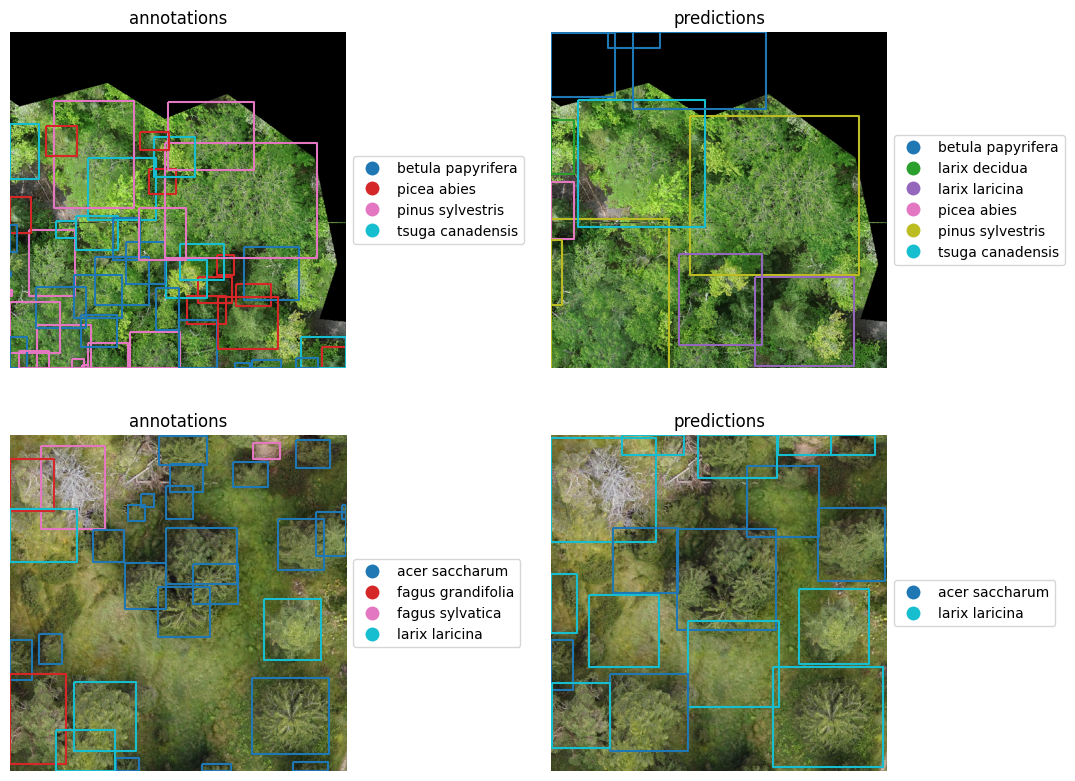
As we can see, there is notable room for improvement, so you can expect this notebook to be updated shortly
References#
Weinstein, B. G., Marconi, S., Aubry‐Kientz, M., Vincent, G., Senyondo, H., & White, E. P. (2020). DeepForest: A Python package for RGB deep learning tree crown delineation. Methods in Ecology and Evolution, 11(12), 1743-1751.
Beloiu Schwenke, M., Xia, Z., Novoselova, I., Gessler, A., Kattenborn, T., Mosig, C., Puliti, S., Waser, L., Rehush, N., Cheng, Y., Xinliang, L., Griess, V. C., & Mokroš, M. (2025). TreeAI Global Initiative - Advancing tree species identification from aerial images with deep learning (TreeAI.V1.2) [Data set]. Zenodo. https://doi.org/10.5281/zenodo.15351054